

Is Starch A Nucleic Acid
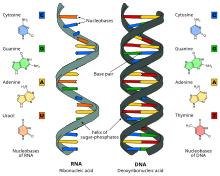
Nucleic acids RNA (left) and DNA (right).
Nucleic acids are biopolymers, macromolecules, essential to all known forms of life.[ane] They are equanimous of nucleotides, which are the monomers made of iii components: a 5-carbon sugar, a phosphate group and a nitrogenous base. The two main classes of nucleic acids are deoxyribonucleic acrid (DNA) and ribonucleic acid (RNA). If the sugar is ribose, the polymer is RNA; if the sugar is the ribose derivative deoxyribose, the polymer is DNA.
Nucleic acids are naturally occurring chemical compounds that serve as the master information-conveying molecules in cells and make upwards the genetic fabric. Nucleic acids are institute in abundance in all living things, where they create, encode, and and then store information of every living cell of every life-form on Earth. In turn, they function to transmit and express that data within and exterior the prison cell nucleus to the interior operations of the jail cell and ultimately to the adjacent generation of each living organism. The encoded information is contained and conveyed via the nucleic acrid sequence, which provides the 'ladder-step' ordering of nucleotides within the molecules of RNA and DNA. They play an especially important function in directing poly peptide synthesis.
Strings of nucleotides are bonded to form helical backbones—typically, i for RNA, two for Deoxyribonucleic acid—and assembled into bondage of base-pairs selected from the five primary, or canonical, nucleobases, which are: adenine, cytosine, guanine, thymine, and uracil. Thymine occurs but in DNA and uracil but in RNA. Using amino acids and the process known every bit protein synthesis,[2] the specific sequencing in Deoxyribonucleic acid of these nucleobase-pairs enables storing and transmitting coded instructions as genes. In RNA, base of operations-pair sequencing provides for manufacturing new proteins that decide the frames and parts and most chemical processes of all life forms.
History [edit]

Nucleic acid was starting time discovered by Friedrich Miescher in 1869 at the Academy of Tübingen, Germany. He gave its kickoff name as nuclein.[4] In the early 1880s Albrecht Kossel further purified the substance and discovered its highly acidic properties. He later on also identified the nucleobases. In 1889 Richard Altmann created the term nucleic acid – at that time Deoxyribonucleic acid and RNA were not differentiated.[5] In 1938 Astbury and Bell published the offset X-ray diffraction pattern of DNA.[6]
In 1944 the Avery–MacLeod–McCarty experiment showed that DNA is the carrier of genetic information and in 1953 Watson and Crick proposed the double-helix structure of Deoxyribonucleic acid.[7]
Experimental studies of nucleic acids plant a major part of mod biological and medical research, and form a foundation for genome and forensic scientific discipline, and the biotechnology and pharmaceutical industries.[8] [9] [ten]
Occurrence and classification [edit]
The term nucleic acrid is the overall name for Deoxyribonucleic acid and RNA, members of a family of biopolymers,[11] and is synonymous with polynucleotide. Nucleic acids were named for their initial discovery within the nucleus, and for the presence of phosphate groups (related to phosphoric acrid).[12] Although first discovered inside the nucleus of eukaryotic cells, nucleic acids are now known to be found in all life forms including within leaner, archaea, mitochondria, chloroplasts, and viruses (There is debate equally to whether viruses are living or non-living). All living cells comprise both DNA and RNA (except some cells such as mature blood-red blood cells), while viruses contain either DNA or RNA, just commonly not both.[13] The basic component of biological nucleic acids is the nucleotide, each of which contains a pentose carbohydrate (ribose or deoxyribose), a phosphate grouping, and a nucleobase.[xiv] Nucleic acids are also generated inside the laboratory, through the apply of enzymes[15] (DNA and RNA polymerases) and by solid-stage chemical synthesis. The chemical methods also enable the generation of altered nucleic acids that are not establish in nature,[16] for instance peptide nucleic acids.
Molecular composition and size [edit]
Nucleic acids are generally very big molecules. Indeed, DNA molecules are probably the largest individual molecules known. Well-studied biological nucleic acid molecules range in size from 21 nucleotides (pocket-size interfering RNA) to large chromosomes (human being chromosome ane is a single molecule that contains 247 million base pairs[17]).
In most cases, naturally occurring DNA molecules are double-stranded and RNA molecules are single-stranded.[18] There are numerous exceptions, however—some viruses accept genomes made of double-stranded RNA and other viruses have unmarried-stranded DNA genomes,[19] and, in some circumstances, nucleic acid structures with three or four strands tin class.[xx]
Nucleic acids are linear polymers (chains) of nucleotides. Each nucleotide consists of iii components: a purine or pyrimidine nucleobase (sometimes termed nitrogenous base of operations or but base of operations), a pentose sugar, and a phosphate group which makes the molecule acidic. The substructure consisting of a nucleobase plus sugar is termed a nucleoside. Nucleic acrid types differ in the structure of the saccharide in their nucleotides–Dna contains 2'-deoxyribose while RNA contains ribose (where the only deviation is the presence of a hydroxyl group). Also, the nucleobases found in the two nucleic acid types are dissimilar: adenine, cytosine, and guanine are found in both RNA and Deoxyribonucleic acid, while thymine occurs in Deoxyribonucleic acid and uracil occurs in RNA.
The sugars and phosphates in nucleic acids are connected to each other in an alternate chain (sugar-phosphate backbone) through phosphodiester linkages.[21] In conventional classification, the carbons to which the phosphate groups attach are the 3'-stop and the 5'-end carbons of the sugar. This gives nucleic acids directionality, and the ends of nucleic acid molecules are referred to as 5'-end and 3'-end. The nucleobases are joined to the sugars via an N-glycosidic linkage involving a nucleobase ring nitrogen (N-ane for pyrimidines and North-ix for purines) and the 1' carbon of the pentose carbohydrate band.
Non-standard nucleosides are also institute in both RNA and Deoxyribonucleic acid and ordinarily arise from modification of the standard nucleosides within the DNA molecule or the principal (initial) RNA transcript. Transfer RNA (tRNA) molecules contain a especially big number of modified nucleosides.[22]
Topology [edit]
Double-stranded nucleic acids are made up of complementary sequences, in which extensive Watson-Crick base pairing results in a highly repeated and quite uniform Nucleic acid double-helical three-dimensional structure.[23] In contrast, single-stranded RNA and Dna molecules are not constrained to a regular double helix, and tin adopt highly complex three-dimensional structures that are based on short stretches of intramolecular base-paired sequences including both Watson-Crick and noncanonical base pairs, and a wide range of circuitous 3rd interactions.[24]
Nucleic acid molecules are ordinarily unbranched and may occur as linear and round molecules. For example, bacterial chromosomes, plasmids, mitochondrial Deoxyribonucleic acid, and chloroplast DNA are commonly circular double-stranded DNA molecules, while chromosomes of the eukaryotic nucleus are usually linear double-stranded Dna molecules.[13] Most RNA molecules are linear, single-stranded molecules, just both circular and branched molecules tin can event from RNA splicing reactions.[25] The full amount of pyrimidines in a double-stranded Dna molecule is equal to the total amount of purines. The diameter of the helix is near xx Å.
Sequences [edit]
One Dna or RNA molecule differs from some other primarily in the sequence of nucleotides. Nucleotide sequences are of slap-up importance in biology since they carry the ultimate instructions that encode all biological molecules, molecular assemblies, subcellular and cellular structures, organs, and organisms, and directly enable cognition, memory, and beliefs. Enormous efforts take gone into the development of experimental methods to make up one's mind the nucleotide sequence of biological Dna and RNA molecules,[26] [27] and today hundreds of millions of nucleotides are sequenced daily at genome centers and smaller laboratories worldwide. In addition to maintaining the GenBank nucleic acrid sequence database, the National Center for Biotechnology Data (NCBI, https://www.ncbi.nlm.nih.gov) provides analysis and retrieval resource for the data in GenBank and other biological data made bachelor through the NCBI web site.[28]
Types [edit]
Deoxyribonucleic acid [edit]
Deoxyribonucleic acid (DNA) is a nucleic acid containing the genetic instructions used in the development and performance of all known living organisms. The chemic DNA was first discovered in 1869,merely its genetic inheritance was not demonstrated until 1943. The DNA segments carrying this genetic information are called genes. Likewise, other Dna sequences have structural purposes or are involved in regulating the employ of this genetic data. Forth with RNA and proteins, DNA is ane of the three major macromolecules that are essential for all known forms of life. DNA consists of two long polymers of simple units called nucleotides, with backbones fabricated of sugars and phosphate groups joined by ester bonds. These two strands run in opposite directions to each other and are, therefore, anti-parallel. Attached to each sugar is one of iv types of molecules chosen nucleobases (informally, bases). It is the sequence of these four nucleobases along the backbone that encodes data. This information is read using the genetic code, which specifies the sequence of the amino acids inside proteins. The code is read by copying stretches of DNA into the related nucleic acrid RNA in a procedure called transcription. Within cells, Dna is organized into long structures called chromosomes. During cell sectionalisation these chromosomes are duplicated in the process of Deoxyribonucleic acid replication, providing each cell its ain complete set up of chromosomes. Eukaryotic organisms (animals, plants, fungi, and protists) store most of their Dna inside the cell nucleus and some of their DNA in organelles, such as mitochondria or chloroplasts. In dissimilarity, prokaryotes (bacteria and archaea) store their DNA only in the cytoplasm. Within the chromosomes, chromatin proteins such as histones compact and organize Deoxyribonucleic acid. These meaty structures guide the interactions between Deoxyribonucleic acid and other proteins, helping control which parts of the Dna are transcribed.
Ribonucleic acid [edit]
Ribonucleic acid (RNA) functions in converting genetic information from genes into the amino acid sequences of proteins. The three universal types of RNA include transfer RNA (tRNA), messenger RNA (mRNA), and ribosomal RNA (rRNA). Messenger RNA acts to carry genetic sequence information between Dna and ribosomes, directing protein synthesis and carries instructions from Deoxyribonucleic acid in the nucleus to ribosome . Ribosomal RNA reads the DNA sequence, and catalyzes peptide bond formation. Transfer RNA serves equally the carrier molecule for amino acids to be used in poly peptide synthesis, and is responsible for decoding the mRNA. In add-on, many other classes of RNA are now known.
Artificial nucleic acrid [edit]
Bogus nucleic acid analogues accept been designed and synthesized by chemists, and include peptide nucleic acrid, morpholino- and locked nucleic acid, glycol nucleic acid, and threose nucleic acid. Each of these is distinguished from naturally occurring DNA or RNA past changes to the backbone of the molecules.
Encounter also [edit]
- Comparison of nucleic acid simulation software
- History of biochemistry
- History of molecular biology
- History of RNA biology – Aspect of history of a biological subject area
- Molecular biological science – Co-operative of biology which studies biological activities at molecular level
- Nucleic acid methods
- Nucleic acrid metabolism – Procedure
- Nucleic acid structure – Biomolecular structure of nucleic acids such as Deoxyribonucleic acid and RNA
- Nucleic acid thermodynamics – Study of how temperature affects the nucleic acid structure
- Oligonucleotide synthesis – Chemic synthesis of relatively brusk fragments of nucleic acids with defined chemical construction
- Quantification of nucleic acids
Notes [edit]
References [edit]
- ^ "Nucleic Acid". Genome.gov . Retrieved i January 2022.
- ^ "What is DNA". What is DNA. Linda Clarks. Retrieved six August 2016.
- ^ Pecker Bryson, A Short History of Nearly Everything, Broadway Books, 2015.p. 500.
- ^ Dahm R (January 2008). "Discovering DNA: Friedrich Miescher and the early on years of nucleic acrid inquiry". Human Genetics. 122 (half dozen): 565–81. doi:10.1007/s00439-007-0433-0. PMID 17901982. S2CID 915930.
- ^ "BIOdotEDU". www.brooklyn.cuny.edu . Retrieved ane Jan 2022.
- ^ Cox G, Nelson D (2008). Principles of Biochemistry. Susan Winslow. p. 288. ISBN9781464163074.
- ^ "DNA Structure". What is DNA. Linda Clarks. Retrieved six Baronial 2016.
- ^ Lander ES, Linton LM, Birren B, Nusbaum C, Zody MC, Baldwin J, et al. (February 2001). "Initial sequencing and analysis of the human being genome" (PDF). Nature. 409 (6822): 860–921. Bibcode:2001Natur.409..860L. doi:10.1038/35057062. PMID 11237011.
- ^ Venter JC, Adams Medico, Myers EW, Li PW, Landscape RJ, Sutton GG, et al. (Feb 2001). "The sequence of the man genome". Science. 291 (5507): 1304–51. Bibcode:2001Sci...291.1304V. doi:10.1126/scientific discipline.1058040. PMID 11181995.
- ^ Budowle B, van Daal A (April 2009). "Extracting evidence from forensic DNA analyses: future molecular biology directions". BioTechniques. 46 (v): 339–twoscore, 342–50. doi:10.2144/000113136. PMID 19480629.
- ^ Elson D (1965). "Metabolism of Nucleic Acids (Macromolecular Dna and RNA)". Annual Review of Biochemistry. 34: 449–86. doi:10.1146/annurev.bi.34.070165.002313. PMID 14321176.
- ^ Dahm R (January 2008). "Discovering Dna: Friedrich Miescher and the early years of nucleic acrid inquiry". Man Genetics. nih.gov. 122 (6): 565–81. doi:ten.1007/s00439-007-0433-0. PMID 17901982. S2CID 915930.
- ^ a b Brock TD, Madigan MT (2009). Brock biological science of microorganisms. Pearson / Benjamin Cummings. ISBN978-0-321-53615-0.
- ^ Hardinger, Steven; University of California, Los Angeles (2011). "Knowing Nucleic Acids" (PDF). ucla.edu.
- ^ Mullis, Kary B. The Polymerase Concatenation Reaction (Nobel Lecture). 1993. (retrieved December 1, 2010) http://nobelprize.org/nobel_prizes/chemical science/laureates/1993/mullis-lecture.html
- ^ Verma S, Eckstein F (1998). "Modified oligonucleotides: synthesis and strategy for users". Almanac Review of Biochemistry. 67: 99–134. doi:10.1146/annurev.biochem.67.1.99. PMID 9759484.
- ^ Gregory SG, Barlow KF, McLay KE, Kaul R, Swarbreck D, Dunham A, et al. (May 2006). "The Deoxyribonucleic acid sequence and biological note of human chromosome i". Nature. 441 (7091): 315–21. Bibcode:2006Natur.441..315G. doi:10.1038/nature04727. PMID 16710414.
- ^ Todorov TI, Morris MD (April 2002). National Institutes of Health. "Comparison of RNA, single-stranded Dna and double-stranded DNA behavior during capillary electrophoresis in semidilute polymer solutions". Electrophoresis. nih.gov. 23 (7–8): 1033–44. doi:10.1002/1522-2683(200204)23:vii/8<1033::Assistance-ELPS1033>3.0.CO;2-7. PMID 11981850. S2CID 33167686.
- ^ Margaret Chase; University of South Carolina (2010). "RN Virus Replication Strategies". sc.edu.
- ^ McGlynn P, Lloyd RG (Baronial 1999). "RecG helicase action at three- and four-strand DNA structures". Nucleic Acids Research. 27 (xv): 3049–56. doi:x.1093/nar/27.15.3049. PMC148529. PMID 10454599.
- ^ Stryer, Lubert; Berg, Jeremy Marker; Tymoczko, John L. (2007). Biochemistry . San Francisco: Westward.H. Freeman. ISBN978-0-7167-6766-4.
- ^ Rich A, RajBhandary UL (1976). "Transfer RNA: molecular construction, sequence, and properties". Almanac Review of Biochemistry. 45: 805–60. doi:10.1146/annurev.bi.45.070176.004105. PMID 60910.
- ^ Watson JD, Crick FH (Apr 1953). "Molecular structure of nucleic acids; a structure for deoxyribose nucleic acid". Nature. 171 (4356): 737–eight. Bibcode:1953Natur.171..737W. doi:10.1038/171737a0. PMID 13054692. S2CID 4253007.
- ^ Ferré-D'Amaré AR, Doudna JA (1999). "RNA folds: insights from recent crystal structures". Almanac Review of Biophysics and Biomolecular Construction. 28: 57–73. doi:10.1146/annurev.biophys.28.1.57. PMID 10410795.
- ^ Alberts, Bruce (2008). Molecular biology of the cell. New York: Garland Science. ISBN978-0-8153-4105-5.
- ^ Gilbert, Walter G. 1980. Deoxyribonucleic acid Sequencing and Gene Structure (Nobel Lecture) http://nobelprize.org/nobel_prizes/chemical science/laureates/1980/gilbert-lecture.html
- ^ Sanger, Frederick. 1980. Determination of Nucleotide Sequences in Dna (Nobel Lecture) http://nobelprize.org/nobel_prizes/chemistry/laureates/1980/sanger-lecture.html
- ^ NCBI Resource Coordinators (January 2014). "Database resources of the National Middle for Biotechnology Data". Nucleic Acids Research. 42 (Database issue): D7-17. doi:ten.1093/nar/gkt1146. PMC3965057. PMID 24259429.
Bibliography [edit]
- Wolfram Saenger, Principles of Nucleic Acid Construction, 1984, Springer-Verlag New York Inc.
- Bruce Alberts, Alexander Johnson, Julian Lewis, Martin Raff, Keith Roberts, and Peter Walter Molecular Biology of the Cell, 2007, ISBN 978-0-8153-4105-5. Fourth edition is available online through the NCBI Bookshelf: link
- Jeremy One thousand Berg, John L Tymoczko, and Lubert Stryer, Biochemistry 5th edition, 2002, W H Freeman. Available online through the NCBI Bookshelf: link
- Astrid Sigel; Helmut Sigel; Roland G. O. Sigel, eds. (2012). Interplay between Metallic Ions and Nucleic Acids. Metal Ions in Life Sciences. Vol. x. Springer. doi:10.1007/978-94-007-2172-2. ISBN978-94-007-2171-5. S2CID 92951134.
Farther reading [edit]
- Palou-Mir J, Barceló-Oliver Thou, Sigel RK (2017). "Affiliate 12. The Function of Lead(II) in Nucleic Acids". In Astrid Southward, Helmut S, Sigel RK (eds.). Lead: Its Effects on Surround and Health. Metal Ions in Life Sciences. Vol. 17. de Gruyter. pp. 403–434. doi:ten.1515/9783110434330-012. PMID 28731305.
External links [edit]
- Interview with Aaron Klug, Nobel Laureate for structural elucidation of biologically important nucleic-acid protein complexes provided by the Vega Science Trust.
- Nucleic Acids Research periodical
- Nucleic Acids Book (free online book on the chemistry and biology of nucleic acids)

Is Starch A Nucleic Acid,
Source: https://en.wikipedia.org/wiki/Nucleic_acid
Posted by: hartungcomple38.blogspot.com
0 Response to "Is Starch A Nucleic Acid"
Post a Comment